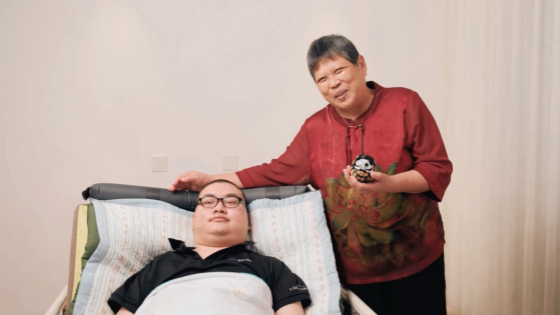
Major Breakthrough in Clinical Trials of High-Throughput Implantable Flexible BCI by Shanghai Team — “Mind-Controlled” Smart Devices and “Thought Dialogue” Become Reality
As the new year begins, a major announcement has emerged from the field of brain-computer interfaces (BCIs).
On January 2, 2025, Shanghai NeuroXess Technology Co., Ltd. (hereinafter referred to as “NeuroXess”), a domestic BCI enterprise, officially announced its breakthrough progress in clinical trials: supported by the Tianqiao and Chrissy Chen Institute (TCCI), and based on its fully independently developed 256-channel high-throughput implantable flexible BCI, the company recently conducted clinical trial research on high-precision real-time motor decoding and language decoding at Huashan Hospital Affiliated to Fudan University, successfully realizing “mind-controlled” smart devices and “thought dialogue.”
This landmark advancement not only encompasses real-time motor decoding, but also achieves an unprecedented breakthrough in real-time Chinese language decoding, marking that China has reached a world-leading level in the BCI field. NeuroXess has thereby become the only invasive BCI enterprise globally to achieve both real-time motor decoding and real-time Chinese language decoding simultaneously.
According to its disclosure, benefiting from high-throughput, high-quality, and cross-brain-region large-scale EEG data collection and real-time analysis, relevant brain functional areas can be accurately located within a few minutes during surgery. Motor and language decoding trials can be initiated just two days post-surgery, and “mind-controlled” smart devices along with “thought dialogue” can be achieved within two weeks. All patients recovered well after surgery.
“Mind-Controlled” Internet Navigation: Opening a New Era of Human-Computer Interaction
The High Gamma band (70-150 Hz) is a high-frequency band in EEG signals, typically associated with the synchronization of complex cognitive functions and neural activity in the brain. It provides detailed information about brain activity, particularly regarding motor and sensory processing. In clinical trials of implantable BCIs, extracting signals from this frequency band helps decode brain intentions with greater precision, achieving mind-synthesized movement.
In August 2024, NeuroXess, in collaboration with Professor Ying Mao and Professor Liang Chen’s team from the Department of Neurosurgery at Huashan Hospital, successfully completed the mind-synthesized movement clinical trial. The subject was a 21-year-old epilepsy patient with a space-occupying lesion in the motor cortex. A 256-channel high-throughput flexible BCI was surgically implanted to monitor the lesion and protect key motor-related brain functional areas. The project team extracted EEG features from the High Gamma band of the neural signals and performed model training, utilizing an LSTM (Long Short-Term Memory) neural network model for continuous time decoding, with an overall system latency of less than 60 ms. Benefiting from the 256-channel high-throughput, high-quality, and high-resolution EEG signals, alongside an independently developed channel-selection algorithm, responsive brain regions could be rapidly and accurately identified for real-time, efficient, and precise decoding. Without needing manual operation, the subject achieved “mind-controlled” gameplay of Ping-Pong and Snake within two days post-surgery.
After two weeks of training, integrated with NeuroXess’s proprietary BCI operating system, XessOS, the subject was able to proficiently navigate popular daily apps such as WeChat, Email, Taobao, Xiaohongshu and Toutiao. The subject also achieved “mind control” over smart homes and intelligent wheelchairs, significantly meeting the basic mobility needs required for the daily life of individuals with motor impairments.
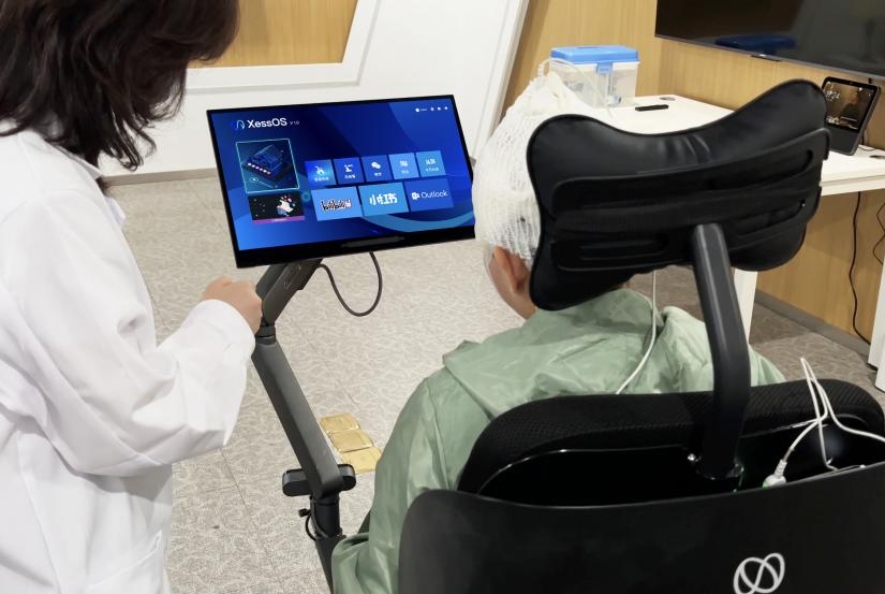
Real-time mind control of the XessOS system.
World’s First “Thought Dialogue” with AI Large Models, Filling Multiple Gaps at Home and Abroad
Chinese is a tonal and logographic language predominantly composed of monosyllables. Unlike alphabetical languages such as English, the information transformation during its production involves a broader array of brain regions, requiring the development of neural encoding and decoding mechanisms as well as information processing methods tailored to the characteristics of the Chinese language. In December 2024, NeuroXess, together with Professor Jinsong Wu’s team from the Department of Neurosurgery at Huashan Hospital, conducted the first clinical trial in China for real-time Chinese language synthesis using a high-throughput implantable flexible BCI. The project team performed flexible BCI implantation on an epilepsy patient with a tumor in the language cortex, using a 256-channel high-throughput BCI to help locate the lesion and protect essential language-related functional brain areas.
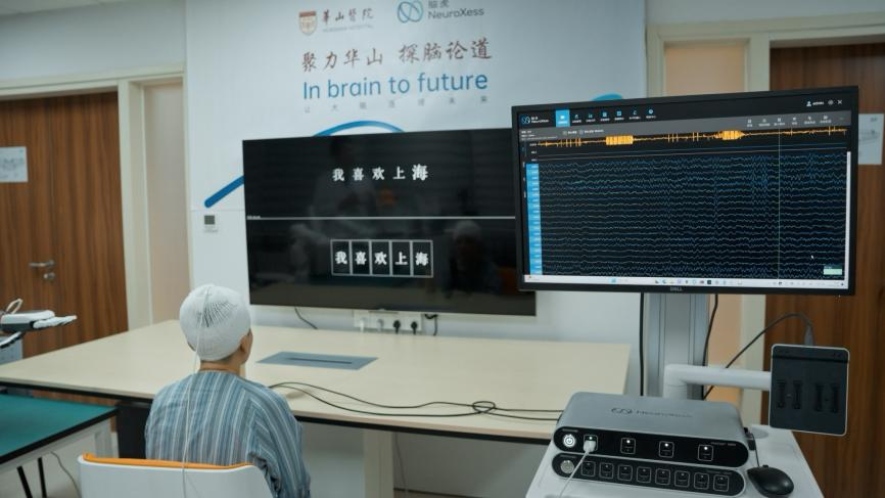
Real-time Chinese language decoding.
The patient recovered well post-surgery and achieved a 71.2% decoding accuracy across 142 common Chinese syllables within five days, with a single-character decoding latency of less than 100 ms—representing the highest level of real-time Chinese language decoding in China today. Based on real-time Chinese language decoding, the subject not only accomplished advanced capabilities such as real-time mind-synthesized Chinese speech, driving a digital avatar, and interacting with large AI language models, but also decoded neural signals into language to convert them into real-time commands for controlling a dexterous robotic hand for human-machine interaction. This achievement brings hope for reconstructing language function in individuals with aphasia, while opening up new possibilities for direct interaction, and even thought exchange, between the human brain and large AI models.
It is worth noting that on the eve of the New Year, the subject also operated a dexterous robotic hand via mind-synthesized speech commands to send everyone a sign language greeting “Happy New Year 2025.”
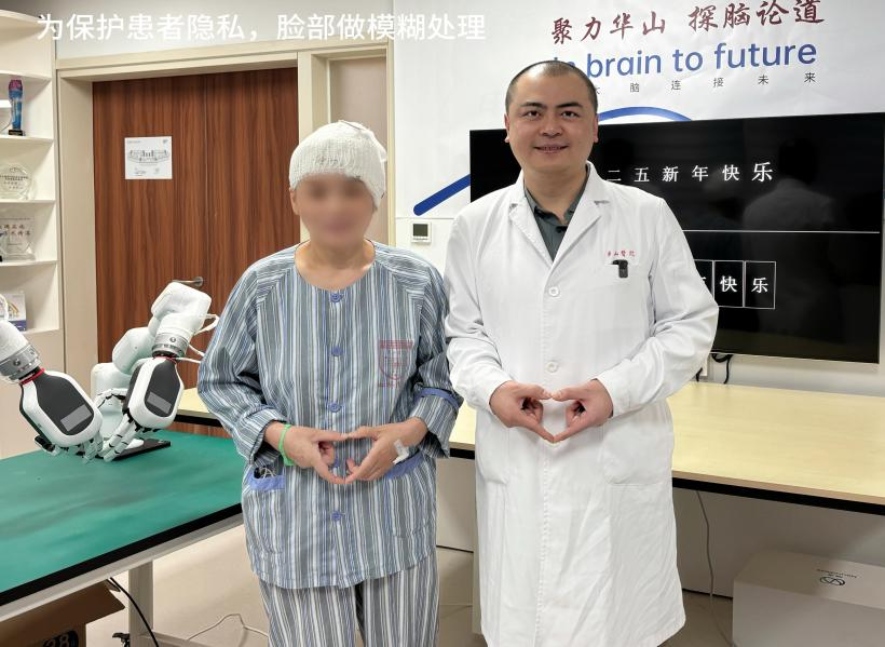
NeuroXess Founder and TCCI Researcher Tiger H. Tao posing with the subject and the mind-controlled dexterous robotic hand forming a heart sign to send New Year wishes.
The breakthrough progress disclosed by NeuroXess benefits from Shanghai’s unique innovation ecosystem and diversified investments from the government, hospitals, and institutions. The related work received strong support from the Tianqiao and Chrissy Chen Institute (TCCI), as well as grants from the General Program of the National Natural Science Foundation of China, the Strategic Frontier Brain-Computer Interface Special Project of the Shanghai Science and Technology Commission, the Frontier Industry Innovative Development Project for Promoting High-Quality Industrial Development of the Shanghai Municipal Commission of Economy and Informatization, and the Shanghai Strategic Emerging Industry Development Special Fund. Support was also provided by organizations including the Shanghai Key Laboratory of Brain-Computer Interface, the Brain-Computer Interface and Interaction Branch of the Chinese Society for Neuroscience, and the Shanghai Future Industry BCI Special Committee.