NeuroXess’s Dual Motor and Language Decoding Technologies Recognized by Top International Journal Nature
In July 2025,, the prestigious international academic journal Nature published an in-depth report titled “China pours money into brain chips that give paralysed people more control,” highlighting China’s breakthrough progress in the field of invasive brain-computer interfaces (BCIs). Two clinical trial achievements by NeuroXess, a leading domestic BCI enterprise—its real-time motor decoding and real-time Chinese language decoding technologies—garnered high attention and coverage from the journal, signifying the recognition of its core technologies by a top-tier global academic publication.
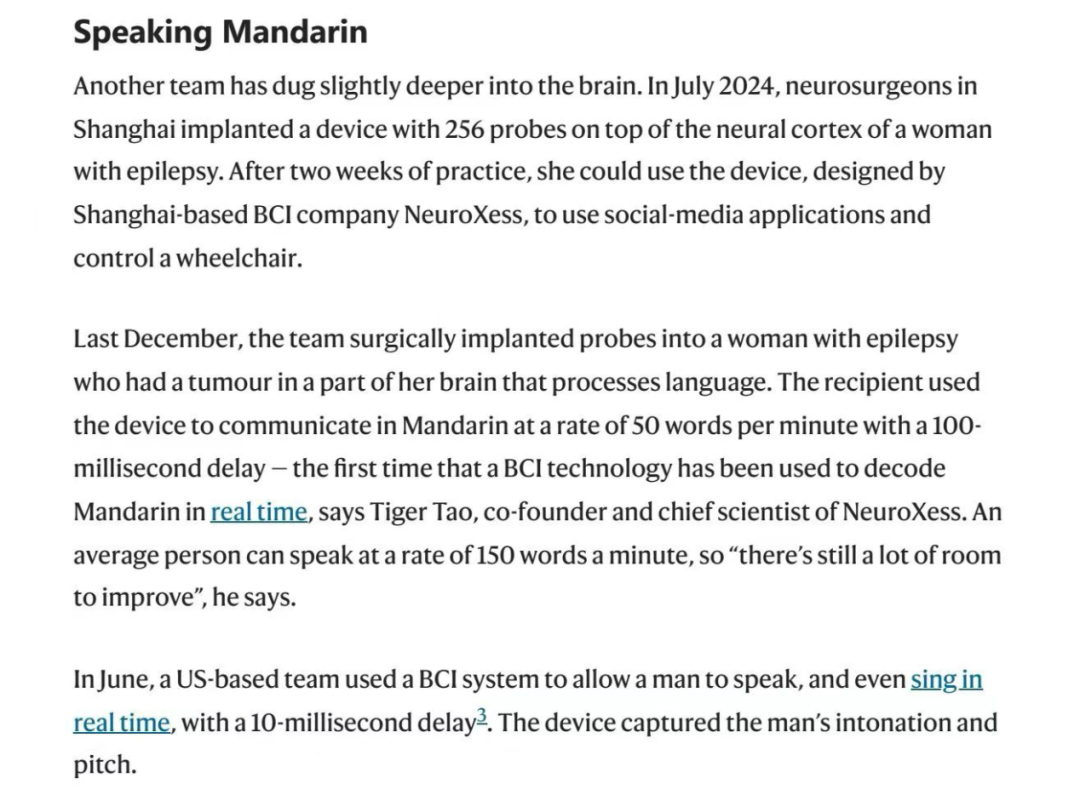
Image excerpted from Nature.
Original link: https://www.nature.com/articles/d41586-025-02098-5
The report introduced two landmark clinical cases from NeuroXess: In July of last year, a patient with motor impairments received an implantation of a 256-channel flexible BCI designed by NeuroXess on the surface of the neural cortex. Following two weeks of training, the patient was able to navigate social media applications and control an intelligent wheelchair via mind control. In December of the same year, a patient with language impairments was implanted with the same device model and, through training, achieved communication in Mandarin Chinese at a rate of 50 words per minute (approximately one-third of the average speaking speed) with a latency of less than 100 ms. This marks the world’s first realization of real-time Mandarin Chinese decoding.
In both cases, NeuroXess chose a subdural placement for the flexible electrodes. Compared with intraparenchymal penetration, this approach substantially minimizes brain tissue damage; meanwhile, compared with epidural placement, subdural positioning sits closer to the cortical surface, capturing neural signals of significantly higher quality and precision. Tiger Tao, Founder and Chief Scientist of NeuroXess, believes that balancing brain functional utilization with trauma minimization represents the central challenge in invasive BCI technology, and subdural placement provides an optimal, well-balanced solution.
These two successful cases fill crucial gaps in China’s domestic BCI landscape, establishing NeuroXess as the only invasive BCI company globally to master both real-time motor decoding and real-time Chinese language decoding technologies.