New BCI Breakthrough: 19-Year-Old Patient Achieves Precise Mind-Controlled Gameplay of “Honor of Kings” and “Black Myth: Wukong”
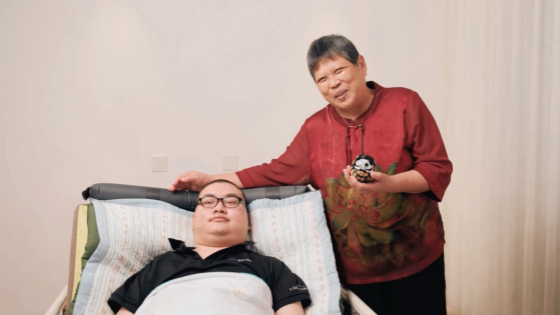
In April 2025, supported by the Tianqiao and Chrissy Chen Institute (TCCI), a clinical trial on high-precision real-time motor decoding conducted by NeuroXess at Huashan Hospital Affiliated to Fudan University achieved another major breakthrough: a 19-year-old patient with right frontal lobe epilepsy was successfully implanted with NeuroXess’s independently developed 256-channel flexible BCI. The patient recovered well post-surgery and smoothly entered the clinical trial two days later.
Following a cumulative 19.87 hours of training with classic paradigms such as Center-out and WebGrid, the subject achieved precise mind-controlled gameplay of classic games like Pac-Man and Battle City, as well as complex AAA titles like Honor of Kings and Black Myth: Wukong. Furthermore, powered by NeuroXess’s proprietary BCI operating system, XessOS, the subject could fluidly navigate the web, operate various apps (Bilibili, Xiaohongshu, etc.), and control smart wheelchairs and smart home devices (lighting, curtains, etc.) purely through thought, significantly enhancing the independent living capabilities of individuals with motor impairments.
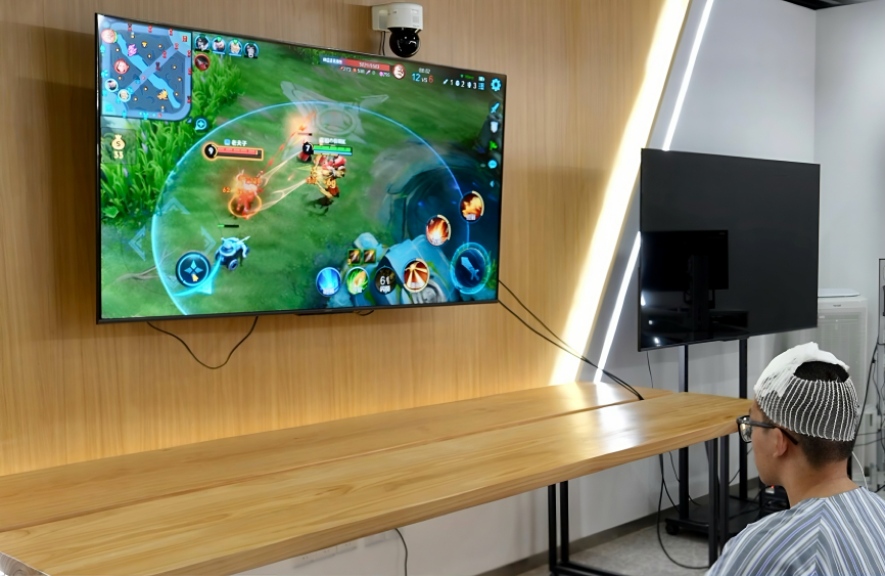
The subject playing “Honor of Kings” via mind control.
Technical Principles: High-Density BCI Training and Continuous Algorithm Optimization for Precise Control
Based on the 256-channel flexible BCI, the research team recorded local field potentials (LFP) and mapped them in real-time to the screen cursor’s movement trajectory, constructing a closed-loop visual feedback control mechanism. This enabled precise control of external devices through the XessOS BCI operating system.
During the training process, the classic Center-out experimental paradigm was utilized to calibrate the decoding model: using a position-velocity Kalman filter algorithm, 256-channel electrocorticography (ECoG) signals were decoded in real-time into cursor velocity commands, allowing the subject to rapidly master closed-loop neural cursor control. As training duration increased, the accuracy and speed of motor imagery control improved significantly.
To further strengthen mind-control proficiency, the WebGrid paradigm was introduced, requiring the subject to move the cursor to specified target grid cells via motor imagery. By gradually increasing grid complexity, the patient’s neural control capabilities were continuously optimized. Once decoder performance stabilized, multi-scenario applications could be expanded through the XessOS BCI operating system.
It is reported that XessOS is a proprietary BCI operating system independently developed by NeuroXess, centered around high-throughput EEG real-time motor decoding algorithms. Integrating dual engines for real-time EEG signal decoding and interaction enhancement, the system executes millisecond-level feature extraction and motor intent parsing to precisely transform neural activity into computer control commands. Equipped with high-efficiency deep learning models and training paradigms, it self-optimizes daily based on the user’s neural characteristics, effectively solving the challenge of neural signal drift. Crucially, the system covers diverse scenarios: supporting smart home adjustments, high-precision wheelchair control, and immersive gaming interactions; while enabling direct “thought connection” to digital life activities such as social messaging, online shopping, and email processing. By constructing a closed loop of “perception-decoding-execution,” BCI technology is deeply integrated into daily life, offering complete solutions across medical rehabilitation, intelligent interaction, and entertainment experiences to empower users to reclaim their autonomy.
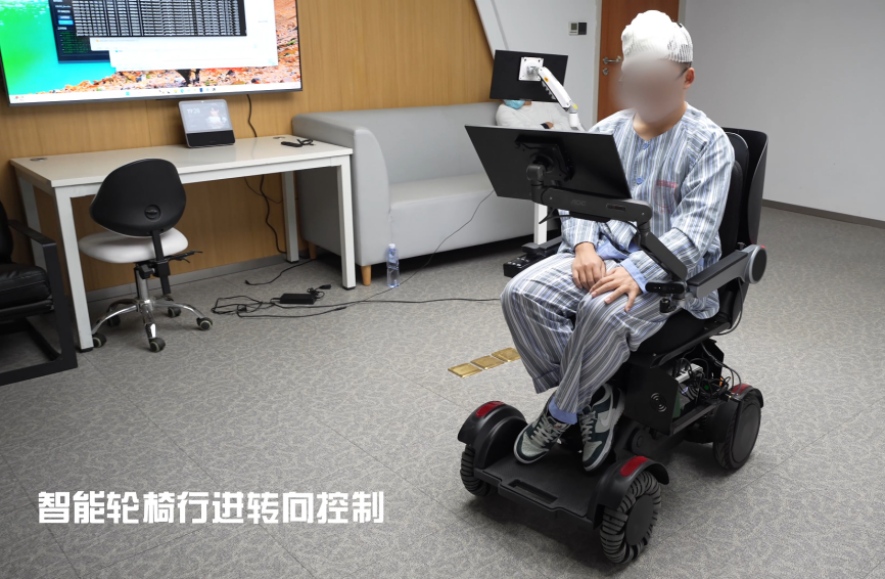
The subject controlling wheelchair movement and steering via mind control.
Clinical Significance: Driving the Transition of BCIs from Foundational Research to Practical Application
Following 19.87 cumulative hours of training, the subject achieved a neural cursor control performance of 4.07 bits per second (BPS) under an enhanced user interface—approaching the 4.6 BPS achieved by Elon Musk’s Neuralink’s first human participant, Noland, after 60 hours of training under an enhanced UI—and gradually drawing closer to the operation speed of healthy individuals using a traditional mouse. NeuroXess stated, “This response speed strongly validates the feasibility of BCI technology in complex real-world scenarios, offering hope for functional reconstruction in patients with motor disabilities.”
It is worth highlighting that throughout the clinical trial, the subject remained in excellent condition and performed exceptionally well. Following the completion of the trial, the medical team at Huashan Hospital utilized NeuroXess’s 256-channel flexible BCI to accurately locate the epileptogenic focus and successfully performed surgical resection, leaving the motor functional areas fully protected. Following recovery, the subject experienced no remaining functional impairments.
Currently, the vast majority of BCIs drag a thin metallic “pigtail”—power and data cables connecting the BCI to data processing hardware. “The research and design for our next-generation fully wireless BCI product has already been completed,” revealed Tiger H. Tao, Founder, CEO and Chief Scientist of NeuroXess. “We expect to initiate clinical trials for the wireless version within the year.”
This breakthrough advancement benefits from Shanghai’s unique innovation ecosystem and diversified investments from government entities, hospitals, and research institutions. The related work received strong support from the Tianqiao and Chrissy Chen Institute (TCCI), along with grants from the Strategic Frontier BCI Special Project of the Shanghai Science and Technology Commission, the Frontier Industry Innovative Development Project for Promoting High-Quality Industrial Development of the Shanghai Municipal Commission of Economy and Informatization, and the Shanghai Strategic Emerging Industry Development Special Fund. Support was also provided by organizations including the BCI and Interaction Branch of the Chinese Society for Neuroscience and the Shanghai Future Industry BCI Special Committee.