World’s First! NeuroXess’s Real-Time Chinese Language Decoding Breakthrough Published in Science Advances, Gaining Widespread Global Attention
In November 2025, NeuroXess, in collaboration with Huashan Hospital Affiliated to Fudan University and the Shanghai Institute of Microsystem and Information Technology (SIMIT), Chinese Academy of Sciences, achieved a landmark breakthrough in the brain-computer interface (BCI) field: its research findings on “high-throughput implantable flexible BCI for real-time Chinese decoding and sentence synthesis” were officially published in the prestigious international journal Science Advances, alongside a dedicated in-depth feature on the official Science website. This marks China’s entry into the leading international ranks in the field of speech BCIs, providing an entirely new paradigm for the global development of BCIs for tonal languages.

Research findings published in Science Advances.
Original Artical Link:https://www.science.org/doi/10.1126/sciadv.adz9968
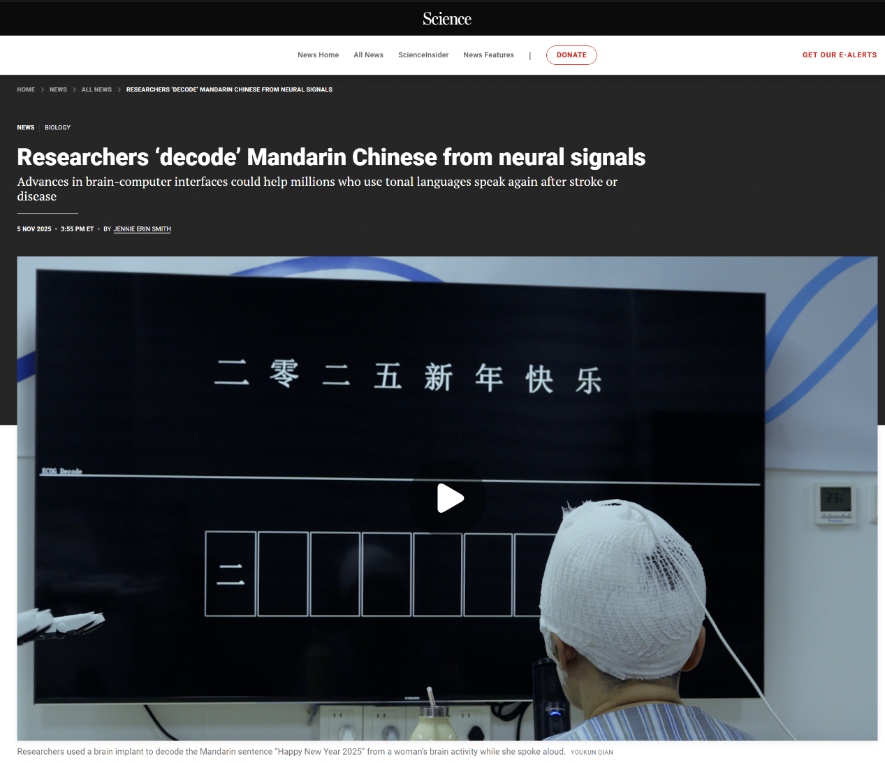
The official Science website features dedicated coverage of the breakthrough.
Link:https://www.science.org/content/article/researchers-decode-mandarin-chinese-neural-signals
Overcoming Global Challenges: Achieving a “0 to 1” Breakthrough in Real-Time Chinese Decoding.
As the tonal language with the largest number of speakers globally, Mandarin Chinese features monosyllabic structures, tone-dependent meanings, and dense homophones with different characters, making real-time Chinese decoding a universally recognized bottleneck in the BCI domain. Previous research has predominantly focused on alphabetical languages such as English. Given that approximately 8 million patients in China suffering from major brain disorders—such as stroke and ALS—have lost their ability to speak, developing a Chinese-adapted BCI is both critically important and urgent.
To address this, the research team achieved targeted breakthroughs by engineering a 256-channel high-throughput implantable flexible BCI, whose micro-cortical electrodes precisely cover key cortical areas to record neural signals. They innovated a real-time neural network decoding algorithm that extracts specific frequency bands (capturing 70–170 Hz High-γ neural activity using a 50 ms sliding window) and integrates language models to output full sentences, establishing a neural encoding and decoding solution tailored to the characteristics of Mandarin Chinese.
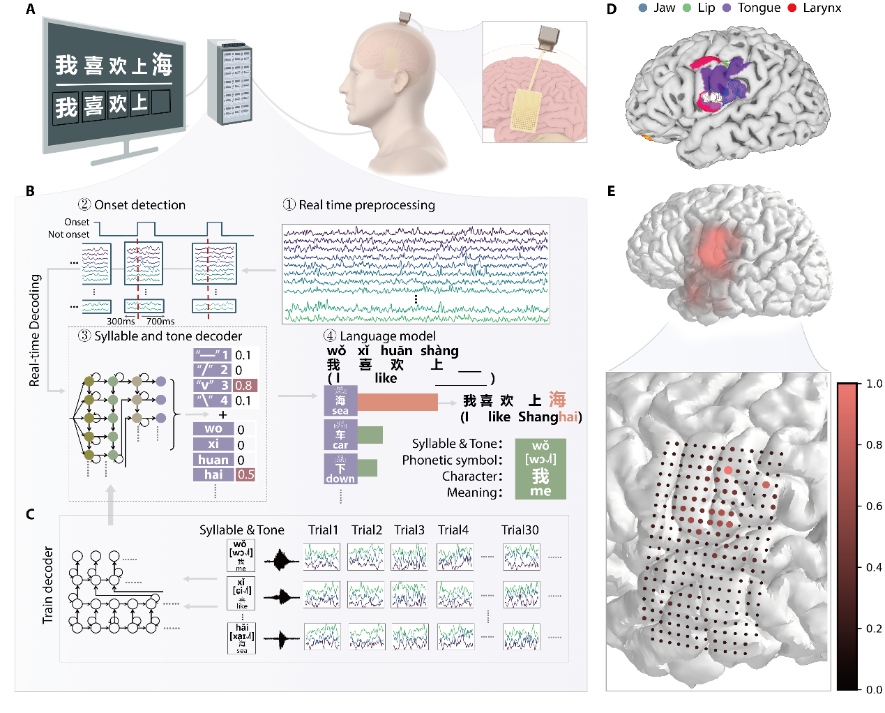
System framework and electrode contribution mapping of the real-time Chinese decoding BCI system.
Impressive Clinical Outcomes: Meeting Daily Communication Needs Within 9 Days of Training
This study enrolled an epilepsy patient with a tumor in the language cortex to conduct Chinese language decoding clinical trials while assisting in locating epileptogenic foci and protecting language functional areas. After just 9 days of training, the system demonstrated remarkable performance: achieving an average accuracy of 71.2% in pure neural decoding across 394 common Chinese syllables (covering over 98% of total Chinese syllables; uncovered syllables were uncommon ones unfamiliar to the subject), with a single-syllable decoding latency of only 65 ms and a real-time sentence decoding speed of 49.6 characters per minute, fundamentally satisfying daily communication needs.
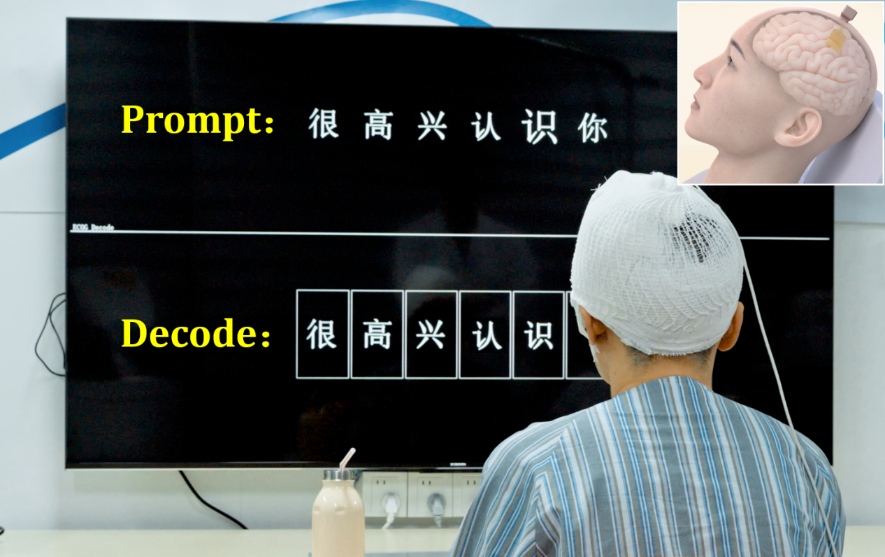
图3:实时汉语解码临床试验
Real-time Chinese decoding clinical trial.
Leveraging this technology and NeuroXess’s independently developed universal BCI operating system, the subject also accomplished several breakthroughs: driving a digital avatar to vocalize, conducting real-time dialogues with large AI models, and accurately controlling a dexterous robotic hand to execute complex actions via neural decoding commands. Ahead of the New Year, the subject conveyed a sign language greeting of “Happy New Year 2025” through thought alone, vividly illustrating the technology’s practical value and humanistic warmth.
Global Industry Acclaim: A Chinese Solution Fills International Gaps
Upon publication, the achievement garnered high attention across international academia. In a dedicated feature published by Science, Matthew Leonard, a neurolinguistics expert at the University of California, San Francisco (UCSF), noted: “The advance could open BCI technology to a massive population of potential users. There are more tonal languages in the world than nontonal languages… This is a major breakthrough in Mandarin speech BCIs in recent years.”
Sergey Stavisky, a BCI researcher at the University of California, Davis (UC Davis), likewise affirmed: “There’s a huge technical leap between speech research in healthy volunteers and a medical-grade BCI for people with communication deficits. Producing characters ‘online’ as a person speaks, rather than analyzing neural data after the fact, is in itself real progress.”
This achievement not only fills an international gap in real-time Chinese decoding, but also provides a reusable technical paradigm for global tonal language BCI research for the first time, laying a solid foundation for China to lead the frontier of this future industry.
Accelerating Clinical Translation: Benefiting 8 Million Aphasia Patients as the Core Goal
“This achievement is merely a starting point; bringing the technology to patients is our ultimate goal,” stated Tiger H. Tao, Founder , CEO and Chief Scientist of NeuroXess. Moving forward, the team will deepen core technology R&D, optimize decoding accuracy and latency, and accelerate clinical translation by partnering with medical institutions to explore standardized treatment pathways for language disorders.
The team also plans to expand application boundaries by exploring deep convergence between BCIs, smart devices, and rehabilitation medicine, helping propel China from a “BCI technology powerhouse” to an “application powerhouse.” This study received support from the Youth Innovation Promotion Association of the Chinese Academy of Sciences (Excellent Member Project), the Shanghai Science and Technology Innovation Action Plan BCI Project, the Fudan University Artificial Intelligence Special Fund, and the Shanghai Magnolia Pujiang Program.